
Tomas Bacutan Taguba was born on January 31, 1919, to Tomas and Buenaventurada (née Bucatan) Taguba in Estefania, Amulung Municipality, Cagayan Province, Philippines. The first several years of young Tomas’s life were relatively uneventful as he helped his father who was a farmer. However, by his 20th birthday, there were serious rumors of growing tensions between the United States and Japan. This could directly affect Filipinos since the Philippine Islands were a territory of the United States.
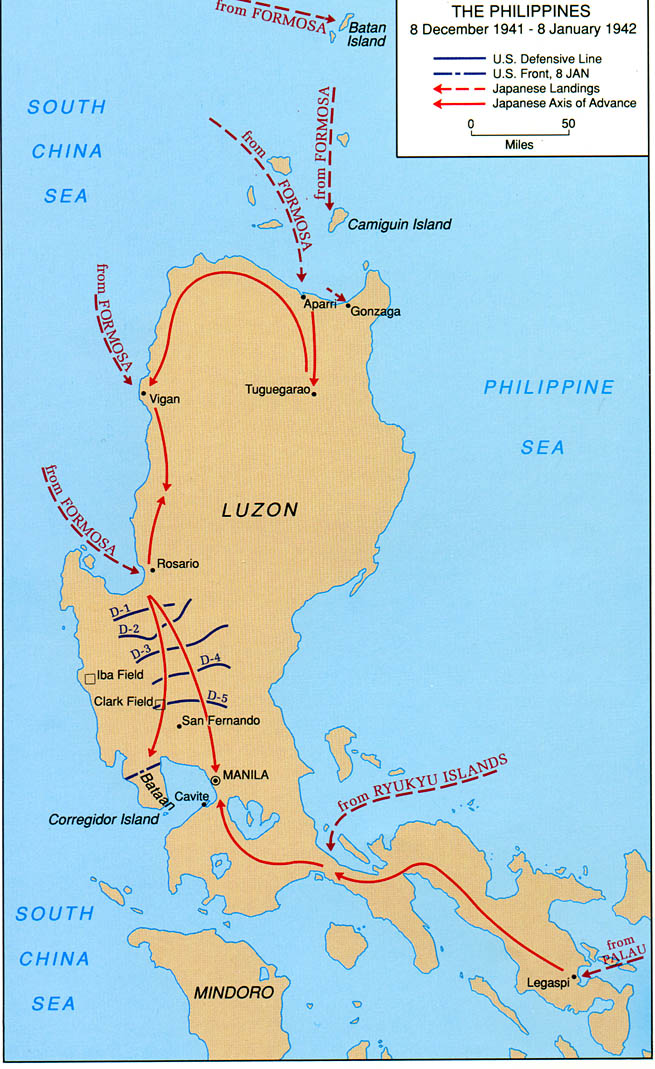
Rumors became reality when Imperial Japan began a coordinated invasion of the Philippines by sea and by air on December 8, 1941, just a few hours after the attack on Pearl Harbor. One prong of the sea invasion started in Taiwan (Formosa) and rapidly progressed south through Luzon Strait to the northern coast of Luzon, the largest of the islands. Part of the attack force made landfall on December 10, 1941, at Aparri, a small village at the mouth of the Cagayan River. A portion of the force split west while the remainder pushed 64 miles south to Tuguegarao via the Cagayan Valley Road, arriving there by December 12, 1941. On the way to Tuguegarao, the Japanese Army passed through Tomas’s (and later Lita’s) hometown of Estefania and then Iguig (home of Lita’s Mother, Maria).
The World War II Battle of the Philippines or the Philippines Campaign lasted five months, from December 8, 1941, to May 8, 1942. Instead of following in his father’s footsteps, Tomas decided to pursue the military as a profession. On February 9, 1942, at the height of the attack and just a few days past his 23rd birthday, he enlisted in the U.S. Army’s Philippine Scouts. Other relatives and friends had reached the same difficult decision.

The Philippine Scouts have a long fascinating history extending back to Spain’s defeat during the 1898 Spanish-American war. The conclusion of that war ended 300 years of Spanish rule and the Philippines consequently became a territory of the United States. President Theodore Roosevelt authorized Filipinos serving with American forces to become part of the U.S. Army by creating the Philippine Scouts. The Scouts later became part of the U.S. Army’s Philippine Division in 1921.
During the Philippines Campaign, Philippine Scouts were some of the first troops to see combat during World War II and proved their courage time and again. For example, the Scouts were instrumental in delaying the Japanese invasion of the Bataan Peninsula (and later Corregidor Island) for several crucial months. After the surrender of American forces at Bataan and Corregidor, Philippine Scouts were among those captured by the Japanese and became prisoners of war, enduring the horrendous Bataan Death March and brutal captivity. Tomas was also captured and forced to join the Death March. However, like a few other Scouts, he later escaped and joined one of the numerous guerilla bands that formed a widespread and remarkably effective resistance movement against the Japanese. When General MacArthur’s forces returned to liberate the Philippines, surviving Philippine Scouts came forward to rejoin the U.S. Army.